
Trace Henry County's Former Owners
Build a backward ownership table from real instruments, one transfer per row. The newest deed goes first. Each later row chases the named grantor back. It follows that party to the deed where it first took title. Henry County deed records supply the dates, deed types, and book and page cites. Those cites keep the audit trail honest. A tax roll entry can flag a missing link. But only the recorder's instruments belong in the table.
| Transfer date | Grantor to grantee | Deed type | Book/page |
|---|---|---|---|
| Newest filing | Prior owner to present grantee | As indexed | Copy exactly |
| Earlier filing | Earlier grantor to prior owner | As indexed | Copy exactly |
| Next earlier filing | Continue the linked names | As indexed | Copy exactly |
Note: Treat this as a working format, never a sample title chain, and copy every field from the Henry Cott index or the recorded image itself.
Henry Deed Records Reach to 1822
Henry County was organized in 1821. Its deed trail opens a year later in 1822. The Cott host splits access in two. One part is a current index with images from 1940 forward. The other part is Online Index Books covering 1822 through 1939. That division is one of the county's most useful features for anyone tracing Henry County property records. The older index can cite a deed book whose images sit offline.
When a citation stops there, the fallback chain runs through the Online Index Books. The next steps are the Clerk of Superior Court Real Estate Division, Henry County Library microfilm, and Georgia Archives or FamilySearch catalog help. Henry County records show no courthouse-fire loss. So a missing web hit is simply unindexed or unscanned, never destroyed.
Online cutoff. Current images and index are stated from 1940 forward; use Online Index Books and offline holdings for 1822 through 1939.
Henry's Grantor-Grantee Entry Point
The Cott land-record source is the remote entry for current and historical deed indexes.
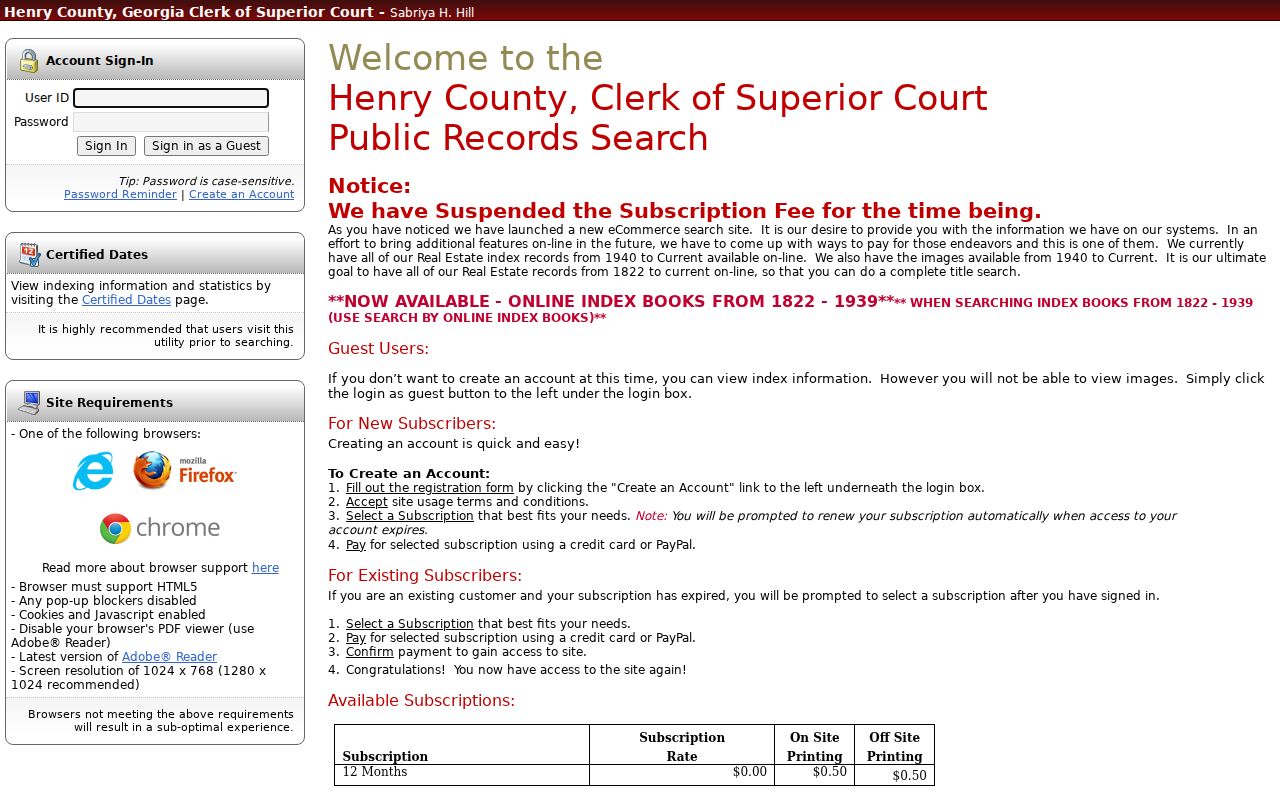
The Cott host may gate deed images behind account conditions. Even so, the index data still yields the book, page, file number, date, parties, and property description you need to request the deed from the Clerk.
Reconstruct Henry Ownership Backward
Ownership runs backward. The grantee received the interest; the grantor conveyed it. Once you hold the current deed, its grantor becomes the next name to chase through the Henry County grantor-grantee index as an earlier buyer.
- Use Henry ARC to capture the present Owner Name, parcel, land lot and district, plat, lot, block, and situs.
- Find that party's newest matching acquisition in Cott. Record the grantor, filing date, kind, file number, book/page, and description.
- Search that grantor as a grantee in an earlier period. Match the land description rather than accepting the first same-name hit.
- Repeat until the index reaches the pre-1940 books, then use the older book entry and offline channels as needed.
- Grantor
- The party conveying the interest stated in an instrument.
- Grantee
- The party receiving that stated interest.
- Chain of title
- The linked sequence of recorded transfers affecting the same land.
- Reverse index
- An index organized to find the opposite party role when walking a chain backward.
- Quitclaim and warranty
- Different deed forms whose legal effect should be read from the instrument, not guessed from the index label.
Henry Plats Hold the Chain
Old Henry County deeds rarely carry a modern street address. Match instead on land lot and district. Then check subdivision, unit, lot and block, acreage, and plat book and page. The HenryParcels GIS map layer adds map number, plat, deeded-name, change-date, and acreage clues. But the recorded deed and plat remain the evidence that matters.
One caution: a parcel split or combination can mint a new parcel number with no sale at all. Before calling that new number an ownership break, compare acreage, change type and date, map number, and plat references. A disputed line calls for a licensed survey.
Bridge Henry Estate Ownership
Chains often fork at an estate. Heirs, executors, administrators, trustees, and companies all change how title moves. Probate files explain the authority behind a succession. The deed index then shows the recorded land transfer in Henry County deed records. The FamilySearch Henry probate catalog lists Letters testamentary from 1856 through 1935. It also includes an index and the McDonough manuscript microfilm reference.
That collection is not a deed database. Use it to bridge a deceased owner of record. Then return to Cott for the executor deed, administrator deed, distribution deed, affidavit, or quitclaim that actually moved the parcel.
Henry Library Extends Prior-Owner Research
Henry County Library's Local History and Genealogy room extends prior-owner work well past the recorder. Its microfilm covers deeds and wills, court orders, marriage records, census material, and local newspapers. Digitized newspaper film reaches back to 1902. Estate notices, sale notices, subdivision ads, and obituaries can explain why a name changed. They never replace the deed itself.
Henry County publishes no confirmed run of city directories. So avoid claiming a reverse directory covers any particular year. The library's newspaper, probate, census, and local-file trail is the working substitute. Check it always against the recorded property records.
Audit Henry's Older Ownership Steps
Before 1940 the access channel changes, but the identity test stays the same. Use Cott's Online Index Books. Copy the book and page, and compare the land description with the later deed. If no image appears, ask for the page at the Clerk's real-estate counter. A matching name alone never links two eras.
Log every prior owner as you go. Each entry should capture the source, spelling used, party role, and date range. It should record instrument kind, grantor and grantee, filed date, and book and page. Matching land clues belong there too. Add a column for gaps. A negative search still has value. It tells the next researcher which names, roles, and volumes were tested.
Names shift shape over the decades. Try initials, surname variants, corporate suffixes, trustee phrases, and estate labels. Georgia's business records can clarify an LLC or corporation. Only the deed places it in the land chain, though. For a deceased party, probate may name an executor or administrator. That later deed restores the link.
Parcel numbers and street names drift. A full legal description does not. Older Henry County instruments may cite land lot and district. They may also cite acreage, bounds, or a subdivision lot. Later assessor and GIS records add map and plat clues. A parcel split can change the number without changing the owner. So compare acreage, change date, map number, and recorded plat before calling it a transfer.
Library newspapers and local-history files add careful color. A legal notice may reveal an estate sale or a subdivision offering. An obituary can explain a family tie. Neither belongs in a deed row unless the recorded instrument confirms the land. It must confirm the parties as well. That restraint keeps a former-owner timeline factual in Henry County property records.
Test Each Henry Prior-Owner Link
A sound chain needs more than consecutive names. The same land must pass through every row. Compare acreage and the full legal description. Land lot and district, subdivision, lot and block, and plat references all matter. Not every instrument is a simple sale. A quitclaim, security deed, release, tax deed, easement, or affidavit can shape the record without moving a former owner's title forward.
Dates need labels. Execution, filing, indexing, assessment, and sale fields mark different events, so state the filed date when an instrument entered the county record and preserve any separate execution date. A zero or odd amount on an assessor sample is never a market sale price.
If a step stays uncertain, mark it open. Ask the Clerk for the referenced instrument. A careful partial chain beats a complete-looking timeline built from unchecked index hits.
Limits of Henry's Ownership History
Henry County's searchable local deed path begins in 1822. Earlier Georgia land-grant context may appear in Georgia Archives Colonial Plats and Warrants. A state grant alone proves no later parcel chain. Gaps can also stem from spelling, initials, an estate, an unindexed image, or a description with no modern address.
Lawful use. Former-owner research supports house history, estate work, and purchase diligence; never use old addresses or names to track or harass a living person.
Document uncertainty instead of filling it. A chain worksheet should cite each deed and note unmatched periods. Distinguish an index hit from an inspected instrument, too. For one current name rather than the historical sequence, use the Henry County current owner record.
Record the search date and channel for every step. An online result, a Clerk counter copy, a library film image, and an archives catalog entry each carry different weight, and that source trail lets another researcher repeat the work.